
Thea Djordjadze
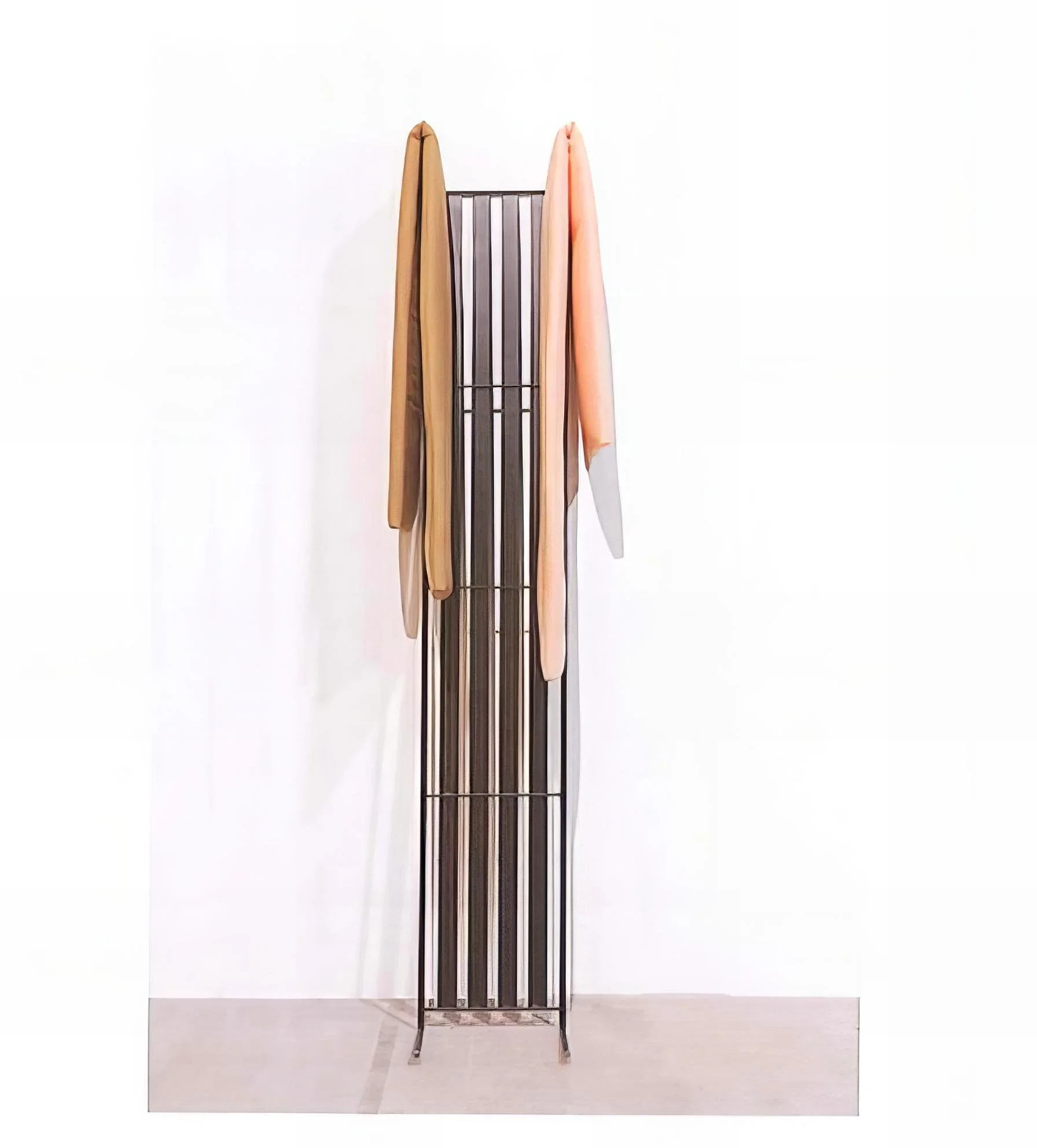
That is the last item on this list: a glass of anger, 2015

steel, lacquer and futon
                                         282 x 80 x 68 cm
About the work
Djordjadze works across sculpture, installation, painting, photography, drawing, video, performance, and music, using installation as the framework through which her pieces engage architectural space. She combines everyday, traditionally "feminine" materials: glass, ceramics, paper, sponge, soap, silicone, textiles with more precious elements like oil paint and gold lacquer. Supported by boxes, railings, or bookcases, her arrangements blend organic and rigid forms to create objects that feel familiar yet remain enigmatic. Drawing on Georgian culture, film, architecture, literature, and archaeology, she balances space and its representation, abstraction and embodiment, modernism and improvisation. Treating the exhibition space as an extension of her studio, she improvises on-site, echoing Marcel Broodthaers's Décors. Her practice intertwines the present with her Georgian heritage and Eastern European cultural history, producing fragile, relic-like constructions that merge minimalist sensibility with echoes of folk culture. Guided by colour, texture, and line, viewers explore works shaped by four recurring elements: modernist design, early-1960s objects, nomadic textiles, and relic-like forms, each contributing to her ongoing effort to stylise and aestheticise memory. Artists such as Alicja Kwade, Rossella Biscotti, Eva Rothschild, Monika Sosnowska, and Paulina Olowska also follow this path in one way or another. For Djordjadze, sculpture almost takes on the role of an icon, but an icon without a frame or pedestal (see the Minimalism of Carl Andre...). The sculpture imposes its own laws; it is a form or an anti-form that takes absolute precedence over any possible interpretation, but it is also an emanation of the artist: sculpture as a physical gesture, which stands in opposition to (very masculine) Minimal Art. The body that created what the viewer sees, the body that sees what has been created and that it was created by someone, whereby Judd's words 'what you see is what you see' are relegated to the realm of fables: Djordjadze's art is not only indebted to American Minimalism but also to Western and Eastern European surrealism with all its historical layers. One could generalise that the Fall of the Wall has put history back at the center of artistic research.
The work in question, 'A glass of anger' formed part of Djordjadze's installation for the 2015 Venice Biennale. Its title comes from Raduan Nassar's 1978 novella 'Um copo de cólera (A Cup of Rage)', rendered as "A glass of anger" in German. Although the artist insists there is no link between the title and the work, viewers are inevitably tempted to search for meaning. The book explores power dynamics between an older landowner and a young journalist, but this context ultimately offers no clear interpretive key. Instead, the installation exemplifies the idea that art poses questions rather than providing answers.
Thea Djordjadze
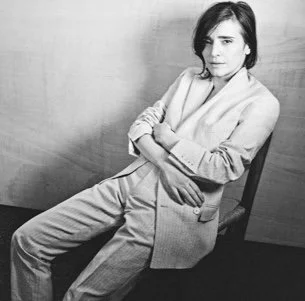
b. 1971, Tbilisi (Georgia).
Lives and works in Cologne.
Thea Djordjadze studied at her hometown's art academy until the civil war forced its closure. She continued at the Rietveld Academy and later at the Kunstakademie Düsseldorf, graduating in 2001 under Dieter Krieg and Rosemarie Trockel, with whom she also collaborated. She has received several awards and exhibited internationally, including at the Venice Biennale (2003), Georgian Pavilion (2013), Kunsthalle St. Gallen, the Lyon Biennale, Kölnischer Kunstverein, Malmö Konsthall, Kunsthalle Basel, the 5th Berlin Biennale, Centre Pompidou, Hayward Gallery, CAM St. Louis, and South London Gallery, as well as solo exhibitions at MoMA PS1 and the Wiener Secession.