
Cathy Wilkes
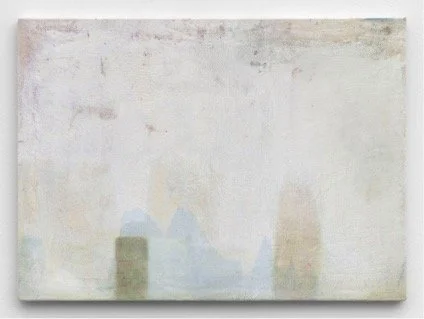
Untitled, 2016

Oil paint and chalk on cotton jersey
                                      41 × 56,5 × 1,8 cm
About the work
This small, untitled painting by Cathy Wilkes was created using oil paint and chalk on cotton jersey.
From a distance, it almost resembles a fleeting sketch. Yet on closer inspection, a far more complex surface emerges. Wilkes builds up the painting layer by layer. She applies paint, rubs parts of it away and then paints over them again. Traces of earlier images remain visible beneath what was added later. This creates a kind of visual palimpsest: an image in which the past never entirely disappears.
The soft, almost hazy colours heighten the impression that we are looking at a memory we cannot fully grasp. Wilkes compares her paintings to music heard from another room: you catch fragments of it, but never the whole.
This interplay between appearance and disappearance is closely connected to her childhood. Cathy Wilkes grew up in Belfast during the Troubles, a period when political and sectarian violence dominated everyday life. Memories of that time recur in her work, but never as a clear autobiographical narrative. Instead, they merge with literature, religious imagery, loss and collective memory.
The paintings sometimes appear not yet fully formed, as though they might vanish again at any moment. Wilkes also deliberately hangs them close to the floor, approximately at a child’s eye level. As adult viewers, we are thus physically returned to a childlike perspective.
Her work raises a poignant question: how can an artist give form to events that exceed the limits of what can be imagined?
In Wilkes’s work, absence also takes on a tangible form. Speaking about her childhood, she once said: ‘Everyone was always present in the room.’ People who had died were spoken of as though they were still part of everyday life.
This is why her figures sometimes resemble ghosts: bodies that are present, but never entirely so. In her installations, too, everyday objects suggest that someone has just left or might return at any moment. An empty coat rack thus becomes a silent reference to an absent person. In Wilkes’s work, the past is never completely over. Memories assume a material form, and those who have died remain part of the present.
Because her images never reveal everything, they leave room for our own memories. What began as something personal thus also becomes collective. Perhaps therein lies the power of this small painting: it attempts to hold on to something before it disappears—an experience, a person, a memory or a barely visible trace of the past.
Cathy Wilkes
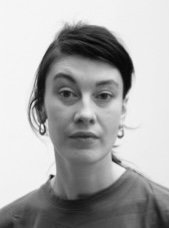
° 1966 in Belfast, Ireland. She lives and works in Glasgow. She studied at the Glasgow School of Art and the University of Ulster.
Wilkes was one of the artists who helped establish Glasgow as an important centre for contemporary art during the 1990s. She was nominated for the Turner Prize in 2008 and became the inaugural recipient of the Maria Lassnig Prize in 2017, leading to a solo exhibition at MoMA PS1 in New York in 2018.
Since the 1990s, she has created installations and assemblages using carefully selected everyday objects. Her work often draws on personal experiences and biography without explaining them explicitly.